Cambodia
CAMBODIA AT A GLANCE
Population
Cambodia has 13.4 million inhabitants with an average density of 74 inhabitants/Km2. The most populated province and also the largest is Khompong Cham, where 14.1% of Cambodians live.
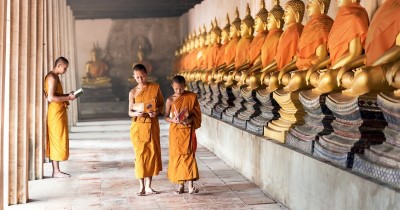
90% of the population is ethnic Khmer (Cambodian). Vietnamese is the largest non-Khmer ethnic group. The rest of the population is made up of Chinese, Muslim Chams and hill tribe minorities in the Eastern part of the country. The dominant religion is Theravada Buddhism.
|
Language A guide is, however duly recommended, as language can be a problem outside the main cities for people who have no knowledge of the Khmer language. |
![]() |
Currency
Though Riel (r) is the official currency; US dollar is indeed the common currency in Cambodia. Many businesses, especially hotels, airlines, restaurants, souvenirs shops, set their prices in USD and all the expenses can be paid in USD even the minor ones. At the time of publishing exchange rate is US$ 1 = 4000 Riel, and 1 Euro = 4800 Riel.
Traveler's cheques can be cashed only at major banks and usually incur a 2 to 5% transaction fee.
Visa, Master cards, JCB, CCB and American Express are accepted in top-end hotels, restaurants and shops in the main cities of Cambodia, such as Phnom Penh, Siem Reap and Sihanoukville, but can also be subject to 2 to 3% transaction fees.
ATMs are now available everywhere in the main cities. You can withdraw cash in USD only - a transaction fees may apply. Banks are usually opened from 08h00 to 15h30 from Monday to Friday. Only a few banks are opened half-day on Saturday.
Climate
Cambodia has a tropical monsoon climate with two seasons: dry from October to May and rainy from June to October. During the rainy season it usually rains only in the evening or very early in the morning. Temperatures are warm all year long.
| Phnom Penh | Jan | Feb | Mar | Apr | May | Jun | Jul | Aug | Sep | Oct | Nov | Dec |
| Max (C) | 31 | 32 | 34 | 35 | 34 | 33 | 32 | 32 | 31 | 30 | 30 | 30 |
| Min (C) | 21 | 22 | 23 | 24 | 24 | 24 | 24 | 25 | 25 | 24 | 23 | 22 |
| Rain (mm) | 7 | 10 | 40 | 77 | 134 | 155 | 171 | 160 | 224 | 257 | 127 | 145 |
| Siem Reap | Jan | Feb | Mar | Apr | May | Jun | Jul | Aug | Sep | Oct | Nov | Dec |
| Max (C) | 35 | 35 | 38 | 39 | 38 | 37 | 38 | 34 | 33 | 33 | 33 | 33 |
| Min (C) | 17 | 19 | 22 | 23 | 24 | 24 | 22 | 23 | 22 | 22 | 20 | 21 |
| Rain (mm) | 3 | 3 | 5 | 69 | 112 | 193 | 133 | 265 | 268 | 117 | 74 | 5 |
Local Time
Cambodia is 7 hours ahead of Greenwich Mean Time. It is the same time zone as Thailand, Laos and Vietnam.
Electricity
In Cambodia electric current is mostly 220V. Sockets are generally of the round two-pin type. Three-pin plug adaptors can usually be found at local markets in Phnom Penh.
Water
It is advisable not to drink water from the tap unless it is boiled properly.
Telecommunications
The telecommunication network includes satellite, landline, mobile, Internet cafes, radios system and GSM (check with you home provider if roaming is permitted). Otherwise you can buy a telephone card via the local telephone provider M-Phone against 15 USD for around 25 minutes of call to a foreign country. International phone calls can be made from the main post offices, private business centers and hotels.
Health & Medical Facilities
Inoculation for yellow fever is a legal requirement for entry into Cambodia by people coming from an infected area. There is otherwise no vaccination required, but visitors are advised to receive inoculations against hepatitis A and B, typhoid and tetanus, as to make sure of whether anti malaria treatment is necessary depending on the region they travel to. Phnom Penh and Siem Reap have good hospitals staffed with foreign medical personnel, however for life threatening injury it is advisable to be evacuated to Bangkok or Singapore and we therefore strongly recommended to take out medical travel insurance.
Transportation
There are two international airports in Cambodia: Phnom Penh International Airport located 20 minutes from the town centre and Siem Reap airport, 7 km from the heart of the town.
Road networks have improved but still need to be upgraded in some areas. To cover a distance, it is reasonable to count an average speed of 50 km/hour.
By speedboat, it takes 6 hours from Phnom Penh to Siem Reap. Journey not recommended for elderly persons and groups.
Helicopter sightseeing in Angkor has become available using safe helicopters flown by qualified pilots.
Shopping
Prices displayed are usually fixed, but in other cases, bargaining is recommended.
Tipping
Tipping is not mandatory although it is appreciated. Note that prices in hotels and restaurants usually include 10% for VAT and 5% for service charges.
Public Holidays
| January 1 | : | New Year's Day |
| January 7 | : | Vietnamese Liberation Day |
| January 25-27 | : | Chinese New Year |
| April 14-16 | : | Khmer New Year |
| April 26 | : | Visak Bochea Day |
| April 30 | : | Royal Ploughing Ceremony |
| May 1 | : | Labor Day |
| May 13-15 | : | King Sihamoni's Birthday |
| June 18 | : | Queen's Birthday |
| September 18-20 | : | Pchoum Benh Festival |
| September 24 | : | Constitution Day & King's Coronation Day |
| October 23 | : | Paris Peace Accords |
INTRODUCTION
CAMBODIA – THE LEGEND OF ANGKOR WAT
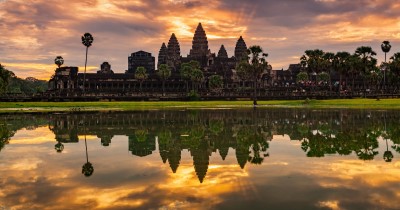
For more than five hundred years, Angkor was the centre of one of the world's great civilizations. ‘Devaraja’ or God-kings ruled a vast area of Southeast Asia from their seat of power on the northern plains of Cambodia. They built immense and dazzling cities and temples to honor both their gods and themselves and decorated them with intricate stone carvings. At its height it is thought that up to one million people lived in and around the temples. But, as with all empires before and since the Khmers mighty civilization slowly crumbled. In 1351 the Thais sacked the city and again in 1431 when the entire population including the royal court moved to Phnom Penh.
Once abandoned the jungle quickly reclaimed the temples and they remained lost to the outside world until their rediscovery in 1860 by the French explorer Henri Mahout.
It has been said that the temples of Angkor represent the finest artistic achievement in human history. To get an idea of the grandeur and magnificence of the art there, imagine the Great Pyramids in Egypt and then imagine that every stone is carved with fantastic stories of myth and legend. To get an idea of the scale both St. Peter’s Basilica in Rome and St. Paul’s Cathedral in London would fit inside the perimeter walls of Angkor Wat.
Cambodia remained hidden from the outside world for much of the last century. Now emerging from years of isolation, the country offers a true taste of Southeast Asia before the arrival of mass tourism and rampant modernization.
Like many other countries in the region Cambodia has had its fair share of tragedy. But its people are nothing if not pragmatic and forward looking and today Cambodia has much to offer the curious visitor.